What Is the Golden Hour on the London Eye?
Plan a London Eye golden-hour ride using date-specific sunset and operating hours, with a realistic allowance for queues and weather.
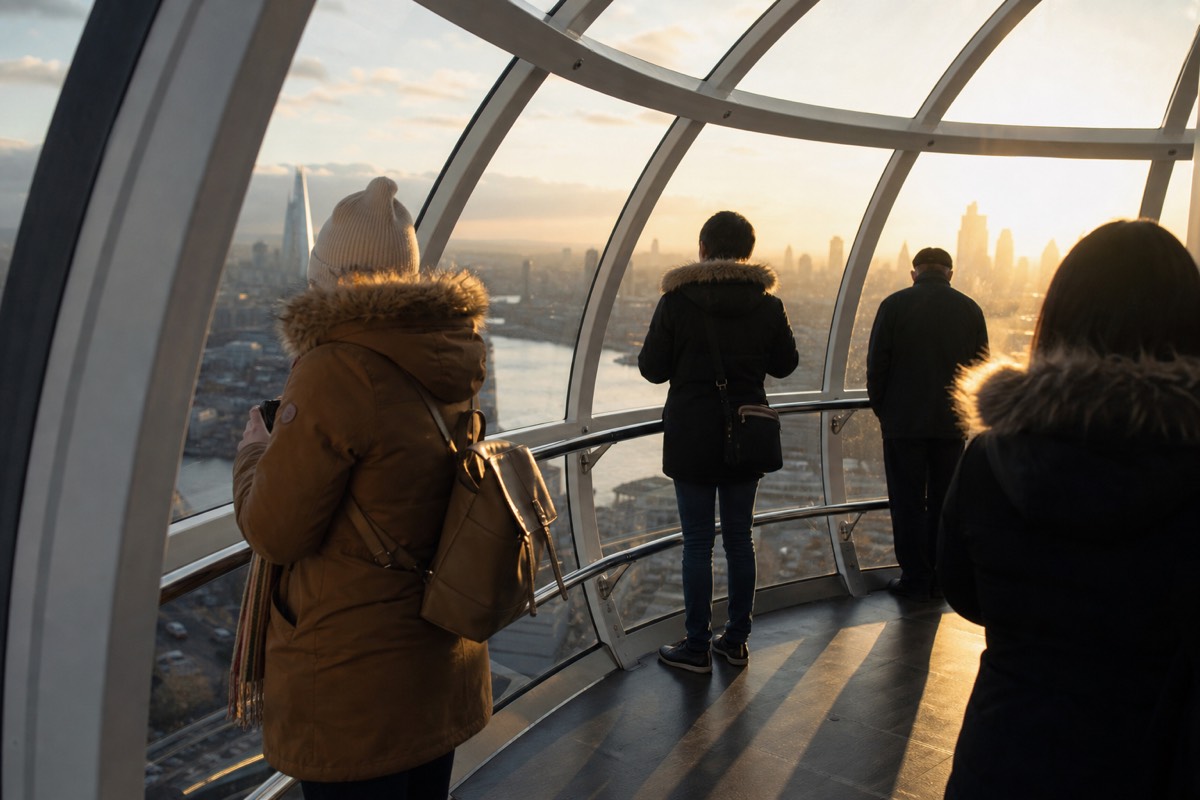
Golden hour is the stretch shortly after sunrise and shortly before sunset when the sun sits low enough that its light travels through more atmosphere, turns warm and orange, and falls sideways across everything instead of straight down. Photographers organise entire days around it. On the London Eye it is worth organising a booking around, because the wheel is one of the few vantage points in central London where you are moving slowly through that light rather than standing still in it.
The 30-minute rotation is what makes it unusual. A viewing platform gives you one fixed angle. The Eye gives you a continuous vertical arc, so a well-timed ride can take in changing low light and the city lights coming on. The capsule passes through the apex rather than stopping there; clouds, queue time and your date affect the photographs.
The timing problem nobody warns you about
Here is the planning catch: sunset shifts substantially through the year, while the Eye’s hours vary by date. Autumn and winter sunsets can fall within an afternoon visit; midsummer sunset may be later than the operating window.
London sits at 51.5 degrees north, which makes its sunset time swing wildly across the year. At the summer solstice the sun sets around 21:22. At the winter solstice it sets around 15:54. That is a gap of more than five and a half hours between the two ends of the calendar.
Now compare sunset with the operating calendar for your actual date. The operator describes closing time as the last rotation time; it does not publish a universal rule that entry always stops 30 to 45 minutes earlier. Midsummer sunset may be outside the available window, but golden-hour light begins before sunset, and seasonal hours should be checked before ruling a date in or out.
Work backward from that and the good months become obvious. Once the evenings start shortening, sunset slides back inside the boarding window, and by late autumn it lands squarely in the middle of a normal operating day. A December sunset ride is an afternoon appointment.
Which slot to actually pick
For standard and fast-track entry, select an available slot for your date. Combo tickets may require a separate Eye reservation through the voucher, and no booking time guarantees particular light.
The rotation takes about 30 minutes, putting the highest point around halfway through a normal ride. Work backward from your preferred light window, then allow time for queuing and boarding. A ticket for 15 to 20 minutes before sunset does not guarantee reaching the top at sunset: the ticket time is when you join the queue, and waits vary. A ride after sunset offers a different city-light view.
Add buffer. Entry is timed and there is still a boarding process at the other end of it, so a slot that starts twenty minutes before sunset does not mean a capsule door closing twenty minutes before sunset.
The direction you will be facing
The wheel stands on the South Bank of the Thames at Jubilee Gardens, with the Palace of Westminster and the whole of Whitehall directly across the water to its west. Westminster lies across the river, making it a useful subject in low light; the sun’s exact direction shifts with the season.
Capsules are shared, and they are sealed glass all the way round, so you are not competing for a single window. You are competing for glass without a reflection in it. That is the real practical problem, and there are only a few things that help. Hold the lens close enough to the glass that nothing behind you can bounce into it. Turn the flash off, because a flash inside a glass box produces exactly one photograph and it is of the flash. Watch what is behind your shoulder, since bright clothing reflects as well as light fittings do. And take the wide shot early in the climb rather than at the top, where everyone crowds the same side.
Why boarding speed matters more than usual here
When light matters, reducing queue uncertainty can be useful. Fast-track uses a separate entrance, but it still involves waiting and security; neither ticket tier fixes the exact minute you board. Compare the upgrade quote with how much flexibility you have around the desired light.
That is the practical case for the Champagne Experience beyond the drink. It carries fast-track priority boarding and a pre-boarding wait in the Eye Lounge rather than in the main queue, with a personal host and a glass of chilled Moet & Chandon Imperial Brut for the standard 30-minute rotation. Choose it if the host, lounge and drink are worth the upgrade to you. Check the experience time against sunset and operating hours; neither the drink nor fast-track entry guarantees clear skies or an exact boarding minute.
If the champagne is beside the point, the standard listing carries the same fast-track option as a choice at checkout, on the same 30-minute rotation. Either way, the decision that matters is the time you pick, not the tier.
Sunset times for a specific date are worth checking before you book, and current opening hours sit on the operator's own site.
Choose Your London Eye Experience
Have your date and target light in mind? Check the available entry options before booking dinner or onward plans; allow time for the queue and changing weather.
London Eye Standard or Fast Track Ticket. A 30-minute rotation. Choose standard or fast-track boarding; security and some waiting remain. Reserve the dated option that suits your party.
Tailor Your Ticket Choice And Compare Costs
- London Eye Champagne Experience: A shared-capsule 30-minute ride with fast-track entrance, an English host, Eye Lounge access and a glass of champagne for adults aged 18+. Security screening still applies.
Choose dates directly on GetYourGuide
Confirm your visit date on the booking page before payment.